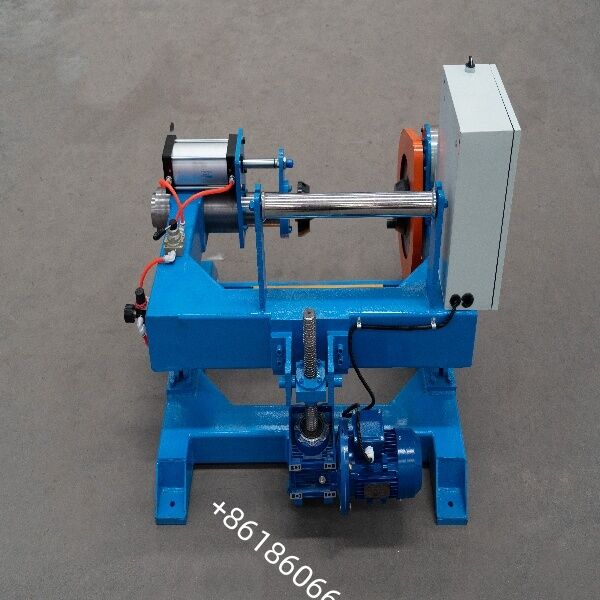
The "Magnetic Pay-off 500-630" refers to a pay-off stand utilizing a magnetic powder or magnetic coupling brake, designed for reels with diameters ranging from Φ500mm to Φ630mm. It is commonly used at the upstream pay-off stage of equipment such as tubular stranding machines and extrusion lines to provide stable tension control and prevent cable tangling or loosening.
**Breakdown of Key Terms**
**Magnetic Pay-off:**
A pay-off stand that employs a magnetic powder brake or magnetic coupling to provide adjustable, smooth passive tension, preventing wire tangling caused by inertia.
**500-630:**
Indicates the applicable reel diameter range, specifically PN500–PN630 (flange outer diameter of approx. 500–630mm); some models support an adjustable range of Φ400–630mm.
**Common Technical Features (Typical Configuration)**
**Tension Control:**
Magnetic powder braking or hysteresis coupling; tension is steplessly adjustable via a controller (common configurations include 5kg or 10kg magnetic powder units).
**Structural Design:**
Shaftless type with dual-end clamping, or single/double-station fixed type; features pneumatic clamping and electric lifting/lowering.
**Load Capacity:**
Maximum load of approximately 600–1,500kg (depending on the specific model and reel size).
**Applicable Wire Diameter:**
Typically φ0.3–5.0mm (copper, aluminum, alloy wires, etc.); customizable based on process requirements.
**Line Speed:**
Passive models can reach speeds of up to approx. 200 m/min; active models equipped with motors allow for synchronized speed control with the main production line.
**Auxiliary Functions:**
Wire-break detection/automatic stop, upper and lower limit protection, and tension adjustment/system linkage via touchscreen and PLC.

1. In Tubular Stranding Machines
Role: Central pay-off + Multi-head pre-pay-off tension source
Central Pay-off
Feeds a central single wire (steel core, copper core, optical fiber, etc.) into the interior of the tubular body.
Magnetic particle braking provides constant tension with back-twist capability; combined with the high-speed rotation of the tubular body, this prevents the central wire from loosening or thinning due to centrifugal force.
Multi-head Pay-off
Independent magnetic particle pay-off stands are configured for multiple single wires at the entry section of the main stranding machine.
Tension for each wire is independently adjustable, ensuring consistent tension across strands, uniform stranding pitch, and excellent roundness of the finished product.
Key Functions:
Prevents the central wire from "wandering" or "looping loose."
Reduces wire breakage rates; supports high-speed operation exceeding 1000 RPM.
Minimizes internal stress and spring-back after stranding.
2. In Extrusion Lines
Role: Front-end tension stabilizer for insulation/sheathing production
Used during the pay-off stage before insulated cores or conductors enter the extruder.
Magnetic particle braking counteracts reel inertia, allowing the wire to enter the extrusion head at constant tension, thereby preventing:
Insulation layer eccentricity.
Uneven wall thickness.
Surface defects such as "bamboo" patterns or chatter marks.
Key Functions:
Ensures consistency in the extruded outer diameter.
Reduces wire accumulation or thinning during start-stop cycles.
3. In Rigid Stranders / Planetary Stranders
Role: Pre-pay-off and auxiliary pay-off unit
Acts as a pre-pay-off stand to smoothly feed multiple reels of single wire into the stranding cage.
Provides gentle, shock-free tension during the stranding of large-cross-section conductors (e.g., ACSR, large-gauge cables) at low speeds, protecting soft aluminum or copper conductors from deformation due to stretching. Key Functions:
Accommodates large-gauge, stranded flexible conductors.
Synchronizes start/stop and tension tracking with the main machine.
4. In Wire Drawing Machines
Role: Pay-off buffering prior to coarse or intermediate drawing
Pays off raw material from large spools (Φ500–630mm) before the coarse or intermediate drawing stages.
Magnetic particle braking absorbs spool inertia, preventing wire overrun ("runaway") and breakage.
Key Functions:
Protects dies and extends drawing die lifespan.
Improves stability of drawing speed.
5. In Bunching Machines
Role: Precision tension control for flexible conductors
Used for the pay-off of fine, flexible copper, tinned, or alloy wires during bunching/stranding.
Low-tension mode prevents stretching or breakage of fine wires; suitable for ultra-fine wires, medical-grade wires, and electronic wires.
Key Functions:
Suitable for fine wires (φ0.03–φ1.0mm).
Enhances the roundness and flexibility of the bunched wire.
6. In Taping / Binding Machines
Role: Constant-tension tape or wire supply
Provides stable unwinding tension for materials such as mica tape, polyester tape, and non-woven fabric.
Prevents tape wrinkling, overlapping, or loosening; ensures the quality of insulation or shielding layers.
Key Functions:
Ensures smooth taping without air bubbles.
Synchronizes with the main machine; automatic tension compensation.
7. In Take-up / Rewinding Lines
Role: Precision tension pay-off unit
Serves as the pay-off unit during processes such as rewinding, inspection, and inkjet marking.
Ensures the wire does not twist or deform during the rewinding process.
Key Functions:
Suitable for precision rewinding of finished cables and semi-finished conductors.
Maintains closed-loop tension matching with the take-up unit.


 Your message must be between 20-3,000 characters!